Sponsoring a Family Member for a U.S. Green Card: Timelines, Requirements and Common Delays

- dimartinolaw
- 0 Comments
- 10 views
- September 20, 2026
Sponsoring a Family Member for a U.S. Green Card: Timelines, Requirements and Common Delays
Two families file family-based green card petitions in the same week. One case is approved within a year. The other is still waiting a decade later, and both outcomes are legally normal. No part of the U.S. immigration system produces more confusion than this, because the timeline is not set by how the case is handled but by three structural facts decided before the first form is filed: who the sponsor is, which relative is being sponsored, and which country the relative was born in.
The encouraging part is that those variables can be understood in advance, which means a family can know what to expect before committing years to the process, and can avoid the handling mistakes that add avoidable months to whatever the structural timeline already is. This guide covers how family sponsorship actually works: the difference between immediate relatives and the preference categories and why it determines everything, the step-by-step process from the I-130 petition to final adjudication, how to read the Visa Bulletin to see where a case stands, the financial sponsorship obligations most sponsors sign without fully understanding, the choice between consular processing and adjustment of status, and the delays that careful preparation prevents.
Why Timelines Vary So Dramatically
Two systems inside one process
Family immigration runs on two tracks that look identical at filing and behave completely differently afterward. One track, for immediate relatives of U.S. citizens, has no annual numerical limit, so the timeline is simply government processing time. The other track, the family preference categories, is subject to annual limits and per-country caps, so the timeline is processing time plus a waiting list, and for some categories and countries the waiting list is measured in many years.
The three variables that set the timeline
Before anything is filed, three questions determine the realistic timeline: is the sponsor a U.S. citizen or a green card holder, what is the exact relationship being sponsored, and where was the relative born, because the per-country limits mean two identical cases from different countries can wait very different lengths of time. Everything else, forms, evidence, interviews, happens inside the frame these three answers create.
Immediate Relatives and Preference Categories
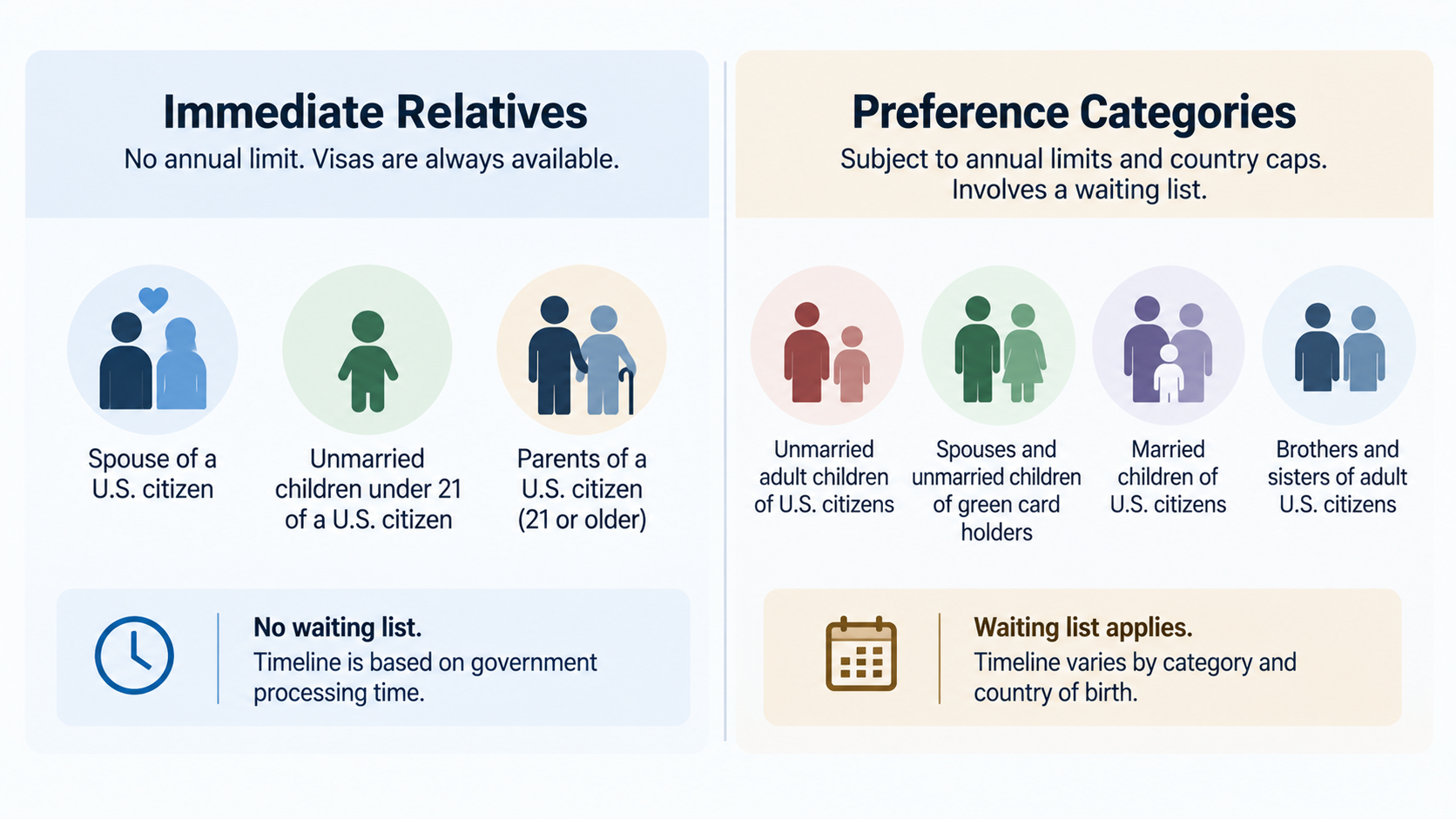
Immediate relatives: no queue
The immediate relative categories cover the spouse of a U.S. citizen, the unmarried children under 21 of a U.S. citizen, and the parents of a U.S. citizen who is at least 21. Visas in these categories are always available, so the case moves as fast as the agencies process it, with no waiting for a visa number.
The family preference categories
Every other family relationship falls into the preference system: unmarried adult children of U.S. citizens, spouses and unmarried children of green card holders, married children of U.S. citizens, and the brothers and sisters of adult U.S. citizens. These categories share a limited annual allocation, capped further by country, and each has its own waiting list. The general pattern is consistent: the closer the relationship and the stronger the sponsor’s status, the shorter the wait, with the sibling category carrying the longest timelines in the system.
Why the sponsor’s status matters
The same relative can sit in different categories depending on the sponsor. A spouse of a U.S. citizen is an immediate relative with no waiting period, while the spouse of a green card holder waits in a preference category. This is why a sponsor’s naturalization mid-process can change a case’s category and timeline, sometimes dramatically for the better, and occasionally in ways that need analysis before acting. It is one of several moments in a family case where a strategic decision hides inside what looks like paperwork.
The Process, Step by Step
Step 1: The I-130 petition
Every family case begins with Form I-130, filed by the sponsor with USCIS, which establishes that the qualifying relationship genuinely exists. For spousal cases this is where the evidence of a bona fide marriage lives: the shared life, documented. The filing fee is set by the current USCIS fee schedule, which changed most recently in 2026 and should be confirmed at filing.
Step 2: The priority date
The date USCIS receives the I-130 becomes the case’s priority date. For immediate relatives it is largely a formality. For preference categories it is the single most important number in the case: it fixes the relative’s place in the queue, and it is the number the family will compare against the Visa Bulletin for years.
Step 3: Visa availability
Immediate relative cases skip this stage. Preference cases wait until their priority date becomes current for their category and country, which is the queue doing its work. Nothing about the case is being evaluated during this period; it is simply waiting for a number.
Step 4: Final adjudication
When a visa is available, the case is completed in one of two ways: adjustment of status inside the United States for relatives already here in eligible circumstances, or consular processing through the National Visa Center and an interview at a U.S. consulate abroad. The choice between them is covered below, because it carries real consequences.
How the Visa Bulletin Works
The monthly map of the waiting line
The Department of State publishes the Visa Bulletin every month, showing, for each preference category and country, which priority dates may move forward. Reading it answers the question every waiting family asks: where does our case stand. If the bulletin shows a date later than the case’s priority date, the case can proceed. If it shows an earlier date, the waiting time is not up yet.
Two charts, two meanings
The bulletin contains two charts: final action dates, which govern when a case can actually be approved, and dates for filing, which sometimes allow the final application to be submitted earlier while the queue finishes. Which chart applies to adjustment applicants in a given month is announced separately by USCIS, a detail that regularly confuses families and occasionally opens a genuine filing opportunity that closes again within weeks.
Movement is not linear
Priority dates do not advance smoothly. They can jump months, crawl, stop, and in some years move backward, which is called retrogression, when demand exceeds the numbers available. A family watching the bulletin should read it as a weather report, not a countdown: informative, current, and subject to change. What the bulletin never changes is the value of being in the queue early, which is why delaying the I-130 is almost never the right move.
The Affidavit of Support: The Obligation Sponsors Underestimate
A contract, not a formality
Nearly every family case requires the sponsor to sign an Affidavit of Support, and most sponsors treat it as one more form. It is not. It is a legally enforceable contract with the U.S. government in which the sponsor promises to maintain the immigrant at a minimum income level, and it can be enforced against the sponsor, including by government agencies recovering certain benefits the immigrant later receives.
The income requirement
The sponsor must generally demonstrate income of at least 125 percent of the federal poverty guidelines for their household size, counting the sponsored relative. Where income falls short, assets can sometimes bridge the gap, or a joint sponsor, who takes on the same legal obligation in full, can be added. Weak or poorly documented financial evidence is one of the most common sources of delay in otherwise strong cases.
What ends the obligation, and what does not
The obligation lasts until the immigrant becomes a U.S. citizen, is credited with roughly ten years of qualifying work, permanently leaves the United States, or dies. Divorce alone does not end the sponsorship contract between the US sponsor and the US government.. A sponsor’s obligations under the affidavit survive the end of the marriage, a fact that deserves clear-eyed attention before signing, particularly for joint sponsors helping a relative’s spouse.
Consular Processing or Adjustment of Status
Who uses which
Relatives already in the United States in eligible circumstances can usually adjust status without leaving, applying for work and travel authorization while the case is pending. Relatives abroad complete consular processing, assembling the civil documents through the National Visa Center and attending an immigrant visa interview at the U.S. consulate serving their country. The routes are not interchangeable, and for relatives inside the United States with complicated histories, entries, overstays, prior filings, the choice between them is a legal analysis, not a preference.
Sponsoring family from Italy and Europe
For families sponsoring relatives in Italy, the consular route runs through the documentary standards this firm works with daily: Italian civil records that must be current and properly issued, certified translations that meet U.S. requirements, and an interview at the US Consulate General in Naples, Italy.. The mechanics are routine when they are prepared correctly and are a recurring source of postponed interviews when they are not, which is where an Italian lawyer for US immigration matters on both sides of the file at once.
The Delays That Preparation Prevents
Thin relationship evidence
The most common RFE in spousal cases asks for more proof that the marriage is genuine. Strong cases document the shared life from the start: joint finances, shared residence, family photographs across time, and consistent details across every form. Assembling this after an RFE costs months compared to assembling it before filing, which is a relative effort.
Financial documentation gaps
Affidavit of Support problems, income calculated on the wrong household size, missing tax transcripts, self-employment income poorly documented, joint sponsors added late, are the second great source of delay, and they are almost entirely preventable at preparation stage.
Notices, addresses, and the 2026 adjudication environment
Cases also stall for mechanical reasons: missed address updates, missed notices, expired medical examinations, and slow RFE responses. The environment around those mistakes tightened this year. Under USCIS policy effective August 5, 2026, officers have restored discretion to deny a filing outright, without first issuing a Request for Evidence, where it does not establish eligibility or omits required initial evidence. The practical standard for family petitions is now the same one this firm applies to every filing: complete and persuasive on the day it is submitted, because the opportunity to fix it mid-process is no longer guaranteed.
Where an Immigration Attorney in Los Angeles Changes the Outcome
A family case cannot be made faster than its category allows, and any honest advisor says so plainly. What counsel controls is everything else: choosing the right category and route, filing early enough to lock the priority date, building the relationship and financial evidence to the standard that avoids RFEs, reading the Visa Bulletin for the openings it briefly creates, and keeping the case moving through every notice and deadline across the years it may run. The same structural rules govern employment-based cases, and families weighing both paths often benefit from seeing them side by side.
An experienced Immigration Attorney in Los Angeles brings exactly that discipline to a family petition. Di Martino Law Group represents U.S. citizens and green card holders sponsoring spouses, children, parents, and siblings, manages both adjustment of status and consular cases, and, as an Italian immigration attorney practice working in English and Italian from Los Angeles, handles the cross-border documentary side for families with relatives in Italy and across Europe end to end.
Starting the Process With Clear Expectations
Family sponsorship rewards two things above all: starting early, because the priority date is the one part of the timeline the family controls, and preparing completely, because in the current adjudication environment the filing has to stand on its own from day one. A family that understands its category, documents its case properly, and respects the mechanics along the way will reach the end of the process in the time the system allows, without adding a single avoidable month to it.
If you are planning to sponsor a family member for a green card, the right time to understand your category and timeline is before you file. Contact Di Martino Law Group for a family immigration consultation.