Inheriting Property in Italy as a U.S. Citizen: The Legal Process and What to Expect

- dimartinolaw
- 0 Comments
- 12 views
- September 19, 2026
Inheriting Property in Italy as a U.S. Citizen: The Legal Process and What to Expect
Every year, thousands of Americans inherit property in Italy, most often through Italian parents, grandparents, or relatives who kept the family home, an apartment, or land in the old country. The inheritance usually arrives at a difficult moment, alongside grief and family logistics, and it comes with something almost no American heir expects: a legal process that runs on Italian law, in Italy, on deadlines that begin at the date of death, whether or not the heir has even understood what they have inherited.
None of it is unmanageable, and this guide is written to make the process legible rather than alarming. It covers why Italian inheritance law works differently from what Americans know, the forced heirship rules at the center of that difference, which country’s law actually governs the succession, the declaration of succession and the twelve-month deadline attached to it, the choice between accepting, limiting, or renouncing an inheritance, how title is transferred into the heir’s name, what happens when several heirs inherit one property, and how the entire process can be managed from the United States without repeated travel to Italy.
Why Italian Inheritance Catches American Heirs Unprepared
A system built on different principles
U.S. inheritance law is built around the will and the probate court: the estate is administered, debts are settled, and what remains is distributed. Italian succession law works differently at its foundation. Heirs step into the legal position of the deceased more directly, the law itself reserves portions of the estate for close family regardless of what any will says, and the administrative steps run through Italian authorities on Italian timelines. An American heir who assumes the process resembles probate at home will be surprised at almost every step.
Debts pass with the assets
The difference with the most practical consequence is this: in Italy, an heir who accepts an inheritance accepts the whole legal position, debts included, and those debts are not automatically limited to the value of what was inherited. Italian law provides a specific protective mechanism for exactly this situation, covered below, but it has to be used deliberately. Accepting first and investigating later reverses the safe order.
The clock starts at the date of death
The key deadlines in an Italian succession run from the date of death, not from when the heir learned of the inheritance or felt ready to deal with it. For heirs an ocean away, that makes early orientation the single most valuable step: understanding what is in the estate, what is owed, and which deadlines apply, before making any move that the law might read as a decision.
Forced Heirship: The Core Difference From U.S. Law
Shares reserved by law
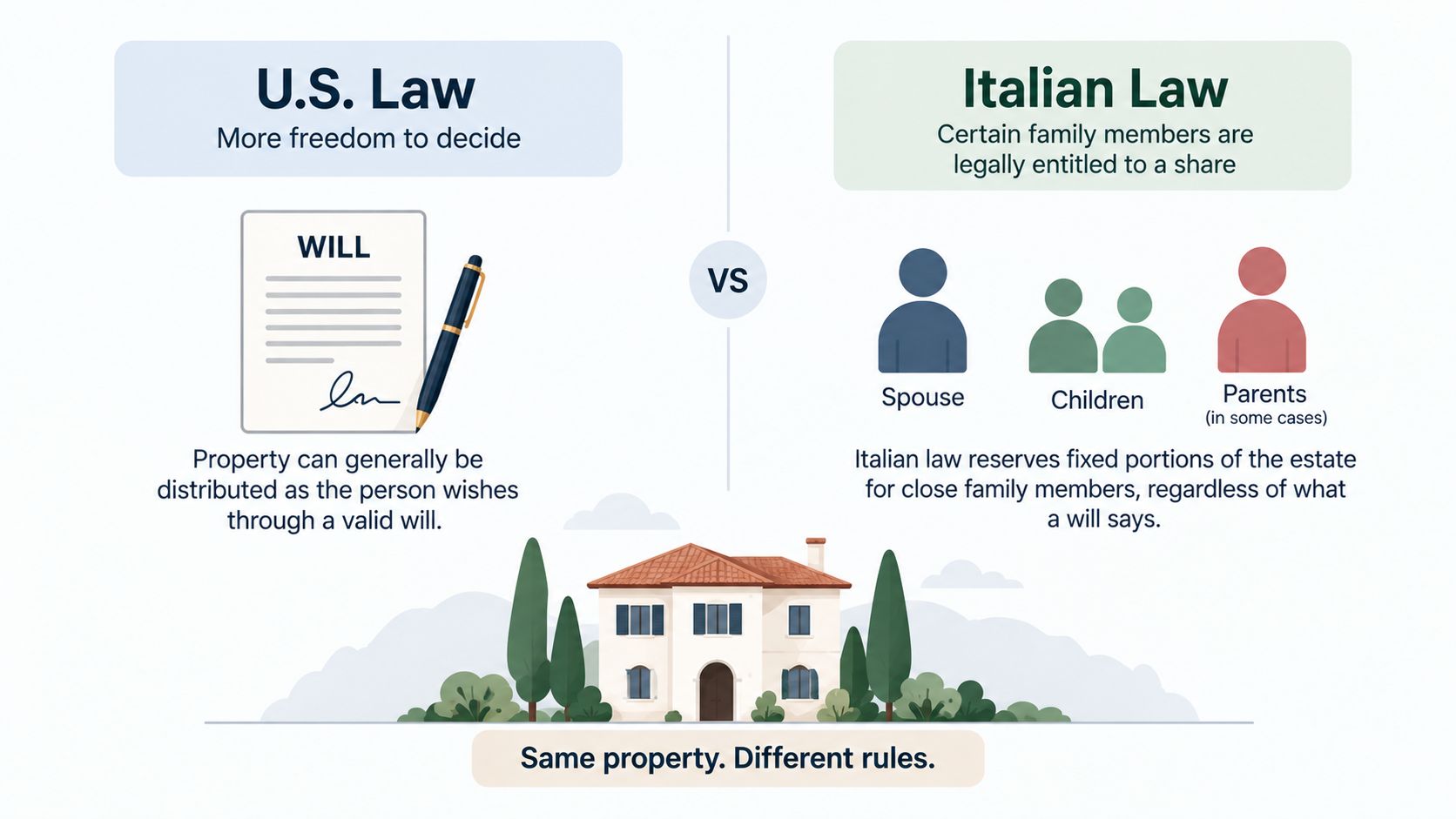
Italian law reserves fixed portions of every estate for the closest family members, the spouse and children, and in some circumstances the parents of the deceased. These reserved shares exist regardless of what a will says. The exact fractions depend on which family members survive, but the principle is constant: only part of an Italian estate is freely disposable, and the rest belongs to the protected heirs by operation of law.
What this means for wills
A will that ignores the reserved shares is not automatically void, but the protected heirs can act to claim what the law reserves for them, which reshapes the distribution the will attempted. For American families this is the sharpest contrast with home: U.S. law broadly lets a person leave property as they wish, while Italian law treats the closest family’s shares as a floor that a will cannot remove.
Why American estate plans collide with it
Many U.S. citizens with Italian property have American wills or trusts drafted purely under U.S. assumptions. When the Italian property passes, the American plan and the Italian rules can point in different directions, and which one prevails depends on the governing-law question below. Heirs encountering a conflict between “what the will says” and “what Italian law reserves” are standing on exactly this fault line, and it is a question for counsel, not guesswork.
Which Country’s Law Governs: The EU Succession Regulation
The default rule, and the choice the deceased could make
Since 2015, successions with a European connection are framed by EU Succession Regulation 650/2012. Its default rule is that the law of the country where the deceased was habitually resident at death governs the succession as a whole. The regulation also allows a person to choose, in their will, the law of their nationality to govern instead. So an American who lived in Italy and owned a home in Liguria, and an Italian citizen who spent her last years in Florida, can end up with entirely different governing law, and a valid choice-of-law clause in a will can change the answer again.
What it means for U.S.-based heirs
For heirs, the practical point is that the governing law is a legal determination made at the start, not an assumption. It decides whether the forced heirship rules apply in full, how the will is read, and how the shares are calculated. The interaction between the regulation and U.S. law has genuinely technical corners, and it is one of the first questions counsel resolves, because everything downstream depends on it. What does not change either way is the procedure: the Italian administrative steps below apply to Italian property regardless of which country’s substantive law governs the shares.
The Declaration of Succession and Its Twelve-Month Deadline
The filing that starts the formal process
Whether or not there is a will, a declaration of succession generally must be filed with the Italian tax authority within twelve months of the date of death. The declaration identifies the deceased, the heirs, and the estate’s assets, including the Italian real estate, and late filing carries penalties that grow with the delay. Limited exceptions exist for small estates without real estate, which by definition do not cover heirs inheriting property.
What it unlocks
The declaration is not a formality to postpone. Until the succession is formalized, the property remains in the deceased’s name and cannot be sold, mortgaged, or divided, and banks will not release the deceased’s Italian accounts to the heirs. The declaration, followed by the registrations described below, is what converts the heirs’ legal position into usable ownership.
Where tax fits
The declaration is also the point at which Italian inheritance taxes and property transfer duties are assessed, based on the estate and the heirs’ relationship to the deceased. The analysis of what is owed, in Italy and on the U.S. side, where reporting obligations can apply to foreign inheritances, belongs with qualified tax advisors. Di Martino Law Group does not advise on tax matters. The firm manages the legal side of the succession and coordinates with the heirs’ tax advisors so that the filings, the payments, and the transfers move together.
Accepting, Limiting, or Renouncing the Inheritance
Acceptance can happen without a signature
Italian law recognizes both express acceptance, a formal declaration, and tacit acceptance, which occurs when an heir behaves in a way that implies ownership, such as taking possession of the property or disposing of estate assets. This is a genuine trap for unadvised heirs: actions taken casually in the weeks after a death can amount to acceptance before the heir has assessed what the estate actually contains. As a rule, the general window for accepting an inheritance runs ten years from the date of death, and an heir already in possession of estate assets faces much shorter timeframes to inventory the estate.
Acceptance with benefit of inventory
The protective mechanism mentioned earlier is acceptance with benefit of inventory: a formal acceptance, made before a notary or the court clerk with an inventory of the estate, that limits the heir’s liability for the deceased’s debts to the value of what was inherited. It is the standard prudent route where the estate’s debts are uncertain, and Italian law requires it in certain cases, including heirs who are minors.
Renunciation
An heir who does not wish to inherit at all can formally renounce, by declaration before a notary or the court clerk. Renunciation must be unconditional, it removes the renouncing heir from the succession entirely, and the share passes to the next person in line, which itself deserves thought, because a renunciation made to avoid complexity can move that complexity onto an heir’s own children. Each of these three routes is a real decision with permanent consequences, and choosing among them is precisely the moment to be advised.
Transferring Title Into the Heir’s Name
Once the declaration of succession is filed, the inherited real estate is registered into the heirs’ names through the Italian land registry and cadastral records. Where the heirs intend to keep the property, this completes the core process. Where they intend to sell, one further point matters: Italian practice generally requires the acceptance of the inheritance to be formally registered before the property can be validly sold, a step American heirs discover late when a buyer is already waiting. Heirs weighing a sale can see the full transaction process in our guide to selling property in Italy as a U.S. citizen, which continues exactly where this article ends.
When Multiple Heirs Inherit One Property
Co-ownership by default
Where several heirs inherit a single property, which is the normal case in Italian family successions, they hold it in hereditary co-ownership: each owns a share of the whole, and significant decisions about the property require the co-owners to act together. A property held by four siblings across two continents can be managed this way, but it cannot be sold, mortgaged, or meaningfully changed by one heir alone.
Agreement, buyout, or division
When co-heirs disagree, i.e. keep or sell being the classic split, Italian law provides a structured way out: the division of the estate, by agreement where possible, including one heir buying out the others at an agreed valuation,or through the courts when there is no agreement, which can ultimately lead to a sale and distribution of proceeds. The negotiated routes are faster, cheaper, and easier on family relationships than the judicial one, which is why counsel’s first job in a disagreement is usually to structure the buyout rather than the lawsuit.
Managing the Entire Process From the United States
Nothing in an Italian succession requires the heir to relocate to Italy, and most of it does not require travel at all. The established route is a specific power of attorney authorizing a trusted representative to act for the heir in Italy: filing the declaration, executing the acceptance in the chosen form, and completing the registrations. For a power of attorney signed in the United States to be valid in Italy, it must be notarized, legalized for international use through the apostille procedure, and accompanied by a proper Italian translation, and it should be drafted for the specific succession rather than in generic terms. Documents flow in the other direction too: U.S. death certificates, civil records, and identity documents need the same legalization and certified translation to be usable before Italian authorities. Prepared correctly, the cross-border layer is administration. Prepared casually, it is the most common cause of a stalled succession.
Why Heirs Need Counsel on Both Sides of the Process
An inherited Italian property places an American family inside Italian succession law, with its reserved shares, its deadlines, and its registrations, while their documents, their decisions, and often their co-heirs sit in the United States. The two sides have to move together: the governing-law analysis, the acceptance strategy, the twelve-month filing, the powers of attorney, and the eventual keep-or-sell decision are one connected sequence, not separate errands.
This is the specific role of an international real estate attorney working across both systems. Di Martino Law Group manages Italian successions for U.S.-based heirs end to end: determining the governing law, advising on acceptance, benefit of inventory, or renunciation, preparing the powers of attorney and translations, filing the declaration of succession, completing the title registrations, and structuring agreements between co-heirs, working in English and Italian from Los Angeles and coordinating with the family’s tax advisors throughout. For American families, working with an Italian real estate attorney in the US means the entire succession is handled in their own language and time zone by an international real estate lawyer who also understands the U.S. side of their documents and decisions.
Approaching the Inheritance in the Right Order
An Italian inheritance rewards the same thing at every step: orientation before action. The heirs who come through the process smoothly are the ones who established what the estate contained before accepting it, chose the form of acceptance deliberately, filed the declaration inside the twelve-month window, registered the title properly, and reached agreement with their co-heirs before positions hardened. Handled in that order, the family home in Italy becomes what it was meant to be, an asset and a connection, whether the heirs keep it, sell it, or redeploy the proceeds into real estate investments in the US.
If you have inherited, or expect to inherit, property in Italy, the right time to understand your position is now, while every option is still open. Contact Di Martino Law Group for an Italian succession and property inheritance consultation.