Setting Up a U.S. Subsidiary for a European Company: Legal Structure and Compliance Requirements

- dimartinolaw
- 0 Comments
- 9 views
- September 18, 2026
Setting Up a U.S. Subsidiary for a European Company: Legal Structure and Compliance Requirements
For a European company, the decision to form a U.S. subsidiary usually arrives at a specific moment: the American market has stopped being an export destination and started being an operation. Customers want a U.S. counterparty on the contract, tariffs and logistics favor a local presence, employees need to be hired on U.S. terms, or a landlord, bank, or enterprise client simply will not deal with a foreign entity. At that point the question is no longer whether to formalize a U.S. presence, but in what legal form, and that choice shapes liability, taxation, governance, and even the immigration options for the executives who will run it.
This guide covers the decisions that define a well-built U.S. subsidiary for a European parent: the difference between a subsidiary, a branch, and a representative office, the choice between an LLC and a C-Corporation, where to incorporate, how parent-subsidiary governance is structured, how the subsidiary is funded, the compliance obligations that continue after formation, and how the structure interacts with L-1 visa eligibility for transferring European executives.
Subsidiary, Branch, or Representative Office: What the Choice Actually Means
The representative office
A representative office is the lightest form of business presence: a location and staff that promote the parent’s business, gather market information, and support relationships, without concluding contracts, engaging in manufacturing processes or conducting revenue-generating activity. It suits the exploration phase, and it stops working the moment the company wants to sell, sign, or hire at scale in the United States.
The branch
A branch is the European company itself operating in the United States, registered to do business but without a separate legal identity. Every contract the branch signs, every obligation it takes on, and every claim made against it lands directly on the parent, with no liability barrier in between. The parent is also pulled directly into the U.S. legal and reporting environment. Branches are common in a few regulated industries, but for most commercial companies the exposure is the reason branches are rare in practice.
The subsidiary and the liability line
A subsidiary is a separate U.S. legal entity owned by the European parent. It signs its own contracts, hires its own employees, holds its own bank accounts, and, critically, contains its own liabilities. Properly formed and properly maintained, the subsidiary places a legal boundary between the U.S. operation and the parent’s assets in Europe. That boundary, together with the credibility of a domestic counterparty for American customers, lenders, and landlords, is why the subsidiary is the standard vehicle for formal U.S. market entry.
Choosing the Entity: LLC or C-Corporation for a Foreign Parent
Why the C-Corporation is the usual answer for European parents
Between the two entity types that matter in practice, the C-Corporation is the default choice for a foreign parent, and for structural reasons rather than habit. A corporation is taxed as a separate U.S. entity, which keeps the parent itself outside the U.S. tax net for the subsidiary’s operations, and it presents a familiar governance shape, shares, a board, officers, that maps cleanly onto how European groups already run their companies. It is also the form U.S. investors, lenders, and larger counterparties expect to see if outside capital or credit becomes part of the plan.
Where the LLC fits, and where it surprises
The LLC’s flexibility makes it excellent for many domestic purposes, but for a foreign parent its default pass-through treatment can produce exactly the result the group was trying to avoid: the parent being treated as directly engaged in U.S. business, with U.S. filing obligations of its own. There are structures where an LLC is deliberately the right answer, but for a European operating company establishing its U.S. arm, that is a conclusion to reach with advisors, not a default to fall into because formation looked simpler.
The tax dimension belongs with tax advisors
Each structure carries different tax treatment in the United States and in the parent’s home country, and the choice should be made with both in view. Di Martino Law Group structures the legal side of the formation and works alongside the group’s tax advisors, so the entity choice, the funding plan, and the tax position are decided together rather than in sequence.
Where to Incorporate: Delaware, California, or New York
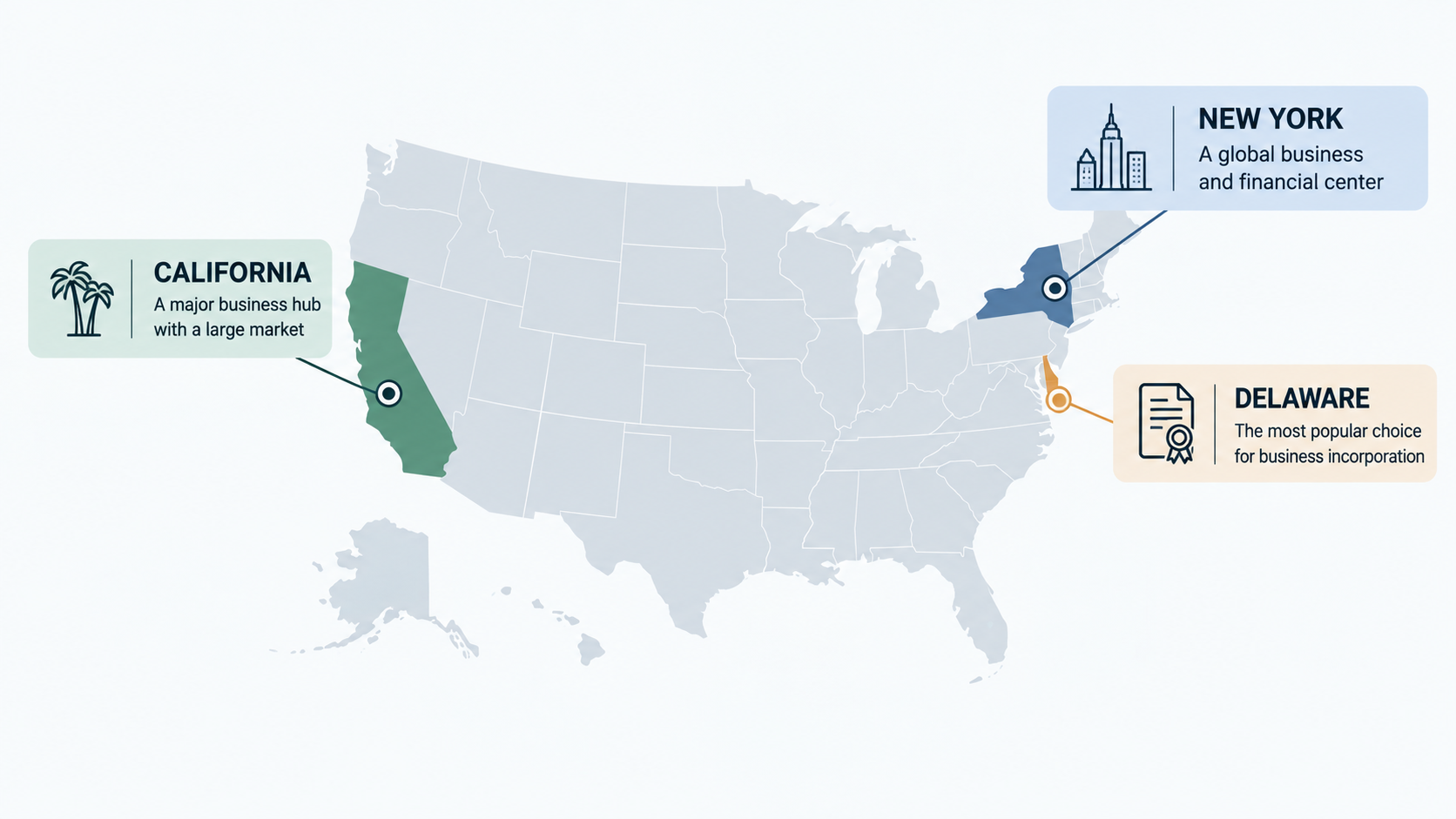
The Delaware default
Delaware remains the standard state of incorporation for subsidiaries of foreign parents, for concrete reasons: the most developed body of corporate law in the country, specialized courts that decide corporate disputes with speed and predictability, and formation mechanics that lawyers, banks, and investors across the world already know. When in doubt, Delaware is the answer that never needs to be explained.
Incorporation is not the same as qualification
Incorporating in Delaware does not exempt the subsidiary from the states where it actually operates. A company formed in Delaware with its office, employees, or sales in California must register there as a foreign entity and comply with California’s requirements, including its annual franchise tax. The practical structure for most European groups is Delaware formation plus qualification in each operating state.
When the operating state should be the formation state
Where the subsidiary will exist entirely within one state, a single office and workforce in California or New York with no multi-state footprint planned, incorporating directly in that state can be the cleaner and cheaper answer, avoiding a second layer of filings. The decision follows the operating plan, which is why the operating plan has to exist before the formation documents do.
Parent-Subsidiary Governance
The board, the officers, and who can serve
The subsidiary’s board is appointed by the parent, and U.S. law is accommodating on composition: there is generally no requirement that directors be U.S. citizens or residents, so the board can be built from the parent’s own leadership, U.S.-based executives, or both. Day-to-day authority sits with the officers the board appoints.
Control mechanisms that actually work
For a wholly-owned subsidiary, control is exercised through documents the parent writes: bylaws or governing documents that reserve defined decisions, budgets, borrowing, major contracts, litigation, admission of new shareholders, for parent approval, and delegated authority limits that state exactly what the U.S. officers can sign alone. Where the subsidiary has a minority co-owner, a shareholder agreement adds the transfer restrictions, board rights, and exit mechanics that protect the parent’s position. Control designed into the documents at formation works quietly for years. Control asserted informally, over documents that never provided for it, fails at exactly the moment it is needed.
Formalities are what keep the liability shield standing
The subsidiary’s separateness is respected only as long as it is real: its own accounts, its own records, decisions taken and documented at the subsidiary level, and no casual mixing of funds or contracts with the parent. U.S. courts can look through an entity that is separate on paper only, and when that happens the liability protection that justified the subsidiary disappears. Corporate formalities are not bureaucracy. They are the price of the shield.
Funding Flows Between a European Parent and a U.S. Subsidiary
Equity, loans, and the discipline of documentation
The parent funds the subsidiary through equity contributions, intercompany loans, or both, and the difference matters. Equity is simple and permanent. Loans offer flexibility on repayment, but they must be real: documented on written terms, at defensible rates, and actually serviced. Undocumented transfers that are equity one quarter and loans the next are a classic source of trouble, in disputes, in audits, and in any later sale of the business.
Intercompany agreements from day one
Where the parent and subsidiary trade with each other, products supplied, services rendered, technology licensed, those relationships should be written into intercompany agreements at arm’s-length terms from the start. Cross-border pricing between related companies is a regulated area in both the United States and Europe, and the detailed treatment belongs with the group’s tax advisors. The legal discipline is simpler: every flow between parent and subsidiary should have a contract behind it.
Ongoing Compliance Obligations
The state-level calendar
Every U.S. entity carries a recurring state compliance load: a registered agent maintained in the state of formation and each state of qualification, annual reports or statements, and franchise or entity-level fees that vary by state. None of it is individually demanding. All of it is deadline-driven, and missed filings can move a company out of good standing, which surfaces at the worst moments, financings, audits, and closings.
Federal reporting that applies to foreign-owned companies
Foreign ownership brings U.S. reporting obligations of its own, including information reporting that applies to foreign-owned U.S. entities regardless of profitability, and beneficial ownership rules whose scope has shifted in recent years and should be confirmed as of the formation date. These filings are routine when they are planned for and expensive when they are discovered late, which is why the compliance calendar should be built during formation, not after the first notice arrives.
Governance maintenance
The same formalities that protect the liability shield, annual meetings or written consents, documented board decisions, updated registers, form the third strand of the ongoing obligations. A subsidiary that is formed correctly and then left unmaintained gradually loses the protections it was built to provide.
How the Structure Interacts With L-1 Visas for European Executives
The qualifying relationship
For many European groups, the subsidiary serves a second purpose: it creates the qualifying corporate relationship on which the L-1 intracompany transfer visa is built. The L-1 allows a parent company to transfer executives, managers, and employees with specialized knowledge to a U.S. entity of the same corporate group, provided the transferring employee has worked for the group abroad for at least one continuous year within the preceding three.
New office petitions are built on the corporate file
When the subsidiary is newly formed, the L-1 petition is filed as a new office case, and USCIS examines exactly the things this article has covered: the reality of the corporate relationship, the physical premises, the business plan, and the subsidiary’s ability to support the executive’s role. New office approvals are typically granted for one year initially, with extensions tied to the operation actually developing. A subsidiary formed with the immigration filing in mind from the start, clean documents, real premises, a coherent plan, moves through this process in a way that an improvised structure does not.
Why the Entity Decision Must Come Before Formation
Every element above, the entity type, the state, the governance documents, the funding structure, is inexpensive to decide correctly at formation and expensive to change afterward. Converting an entity type mid-life, moving a company between states, or repapering undocumented funding all carry legal cost, potential tax consequences, contract assignments, and time, and they tend to become urgent precisely when the business is succeeding: at a financing, an acquisition, or a major contract. The pattern across all of it is the same one that runs through cross-border work generally: structures designed before they are needed work quietly, and structures improvised under pressure charge interest.
Where the Right Counsel Fits a European Expansion
A U.S. subsidiary of a European parent lives in two legal systems at once. The formation, governance, and compliance run under U.S. law, while the shareholder sits under the corporate law of Italy, Germany, France, or wherever the parent is organized, and the two sides have to fit: the parent’s approval requirements, its financing rules, and its group policies all shape what the U.S. documents should say. Advice from within only one system answers half the question.
This is the specific value of an Italian corporate lawyer practicing U.S. law: the structure is designed with both sides in view, in the languages of both, within a single engagement. Di Martino Law Group advises European companies, and Italian companies in particular, on U.S. subsidiary formation end to end, entity selection, incorporation and qualification, governance documents, intercompany agreements, and the ongoing compliance calendar, coordinating as an international law with the group’s home-country counsel and tax advisors, and aligning the corporate structure with the international business law and immigration work that surrounds a market entry. For European groups entering through California, working with a corporate attorney in Los Angeles who is also an international business law attorney means the U.S. entity is built to both markets’ standards from day one.
Building the U.S. Entity Right the First Time
A U.S. subsidiary is the platform on which everything else in an American expansion stands: the contracts, the hiring, the banking, the visas, and eventually the financing or the exit. The European companies that expand well are the ones that treated formation as a set of connected decisions, structure, state, governance, funding, compliance, immigration, made once, together, before the first document was filed.
If your company is planning a formal U.S. market entry, the right time to design the subsidiary is before it exists. Contact Di Martino Law Group for a U.S. subsidiary formation consultation.